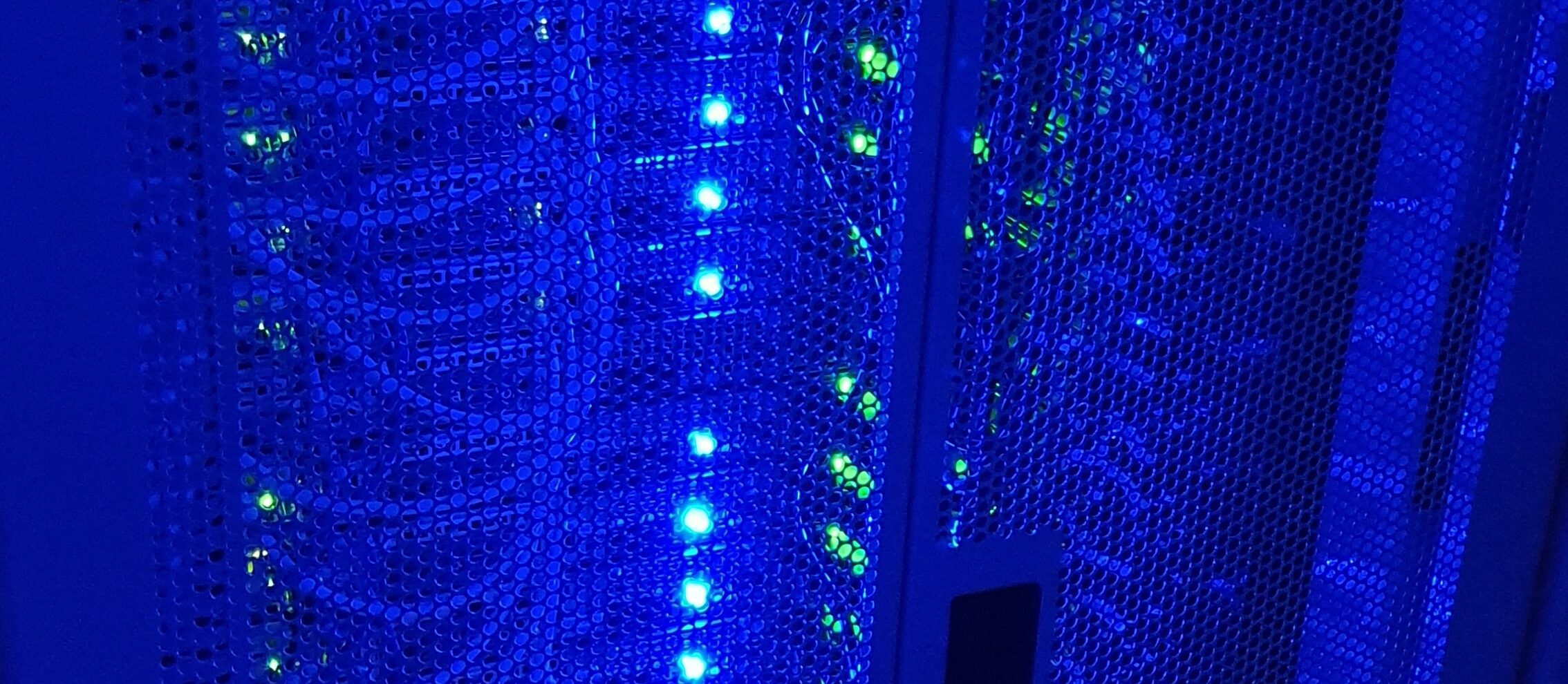
Filtered where the packet lands, not where it hurts.
Our filter is an eBPF program attached to the receive path of every network card in the Sofia scrubbing cluster. A packet is classified and dropped before the kernel allocates a buffer for it. That is why a drop costs nanoseconds, and why capacity is measured in a hundred million packets per second per server and a billion per cluster.
Real photo of our own servers and data center, not AI-generated.
1000M ppsfiltered per cluster: ten servers at 100M each, measured
4 Tbpsfiltering capacity per cluster: ten servers at 400G each, ConnectX-8
<1 sfrom first attack packet to enforced rule
Always onin production since 2024. No activation, no diversion, no null routes
Where a packet is filtered, by design
Most providers inspect traffic after the operating system has already paid for it. We attach to the driver receive path, so a dropped packet costs a few nanoseconds and never touches the stack. The filter is our own code, written and run by the engineers who answer your ticket, not a scrubbing service bought from another company.
XDP in the NIC driver
The filter is an eBPF program on the receive path of an NVIDIA ConnectX-8 or BlueField-3 adapter, 400G each. A packet is classified and dropped before a socket buffer is ever allocated; everything the kernel does is still there for the traffic we keep.
A cluster, not a box
At least ten Dell PowerEdge R670 filtering servers per cluster, load shared by weighted ECMP. Each holds its proportional share of every budget, so the group enforces the figure that is written down. Adding a server raises capacity without loosening a single limit.
Reloadable under fire
The filter can be replaced while traffic is flowing, without dropping a packet and without losing connection state. A new attack vector is a rule written, verified and loaded. It is not a firmware release, a maintenance window or a support case with a vendor.
How it decides
01
L3: volumetric absorption
Amplification and reflection floods dropped at the cluster your server hangs off. Capacity is per cluster, not pooled across a region.
02
L4: stateful TCP defence
SYN cookies, connection tracking and rate limits keyed on the TCP option fingerprint, so a flood is separated from a busy server.
03
L7 payload: protocol validation
Payload judged on its bytes, never on its port number. A DNS reply is recognised as DNS wherever it arrives; Source engine, RakNet, SIP and RTP are recognised as themselves.
Policy
Your server is never blackholed.
A prefix under attack keeps being announced and keeps being reachable. Dropping a customer off the internet to save the network is not mitigation, it is the attacker's objective reached by other means, and it is the one thing we have never done.
What the filter handles: 51 vectors, each with its own counter, threshold and drop reason
TCP
Handshake
SYN flood, SYN+ACK flood, ACK+PSH flood, FIN flood, RESET flood
Thresholds set against your measured baseline, not an industry default
Never null-routed as our mitigation
Incident record with pcap after every mitigation
Topology
On-net: your server is already behind the filter
The scrubbing cluster in Sofia sits in the same network as your server, behind the same Juniper MX304 border routers and QFX10008 fabric. There is no tunnel to a scrubbing centre elsewhere, no BGP diversion when an attack starts and no re-convergence when it stops. The filter is on the path your traffic already takes, so the only latency it adds is the nanoseconds of the decision. Our network runs five more scrubbing clusters (London, Amsterdam, Frankfurt, Marseille, Bucharest) and four edge nodes (Bratislava, Budapest, Thessaloniki, Istanbul) over our own EVPN-MPLS backbone on our own DWDM wavelengths; an attack arriving at any of them is dropped at the nearest cluster before it ever heads for Sofia.
"An attack was blocked" is not a report.
Every mitigation leaves a record: which rule fired, what threshold it crossed, what the traffic was made of, and a packet capture you can open in your own tools without taking our word for any of it. Today it comes by ticket from the engineer who handled the incident, not from a panel or an autoresponder.
The decision
Which rule fired, what its threshold was and by how much it was exceeded. You get the actual number and the actual limit instead of a severity colour, so you can tell a rule that was nearly wrong from one that was obviously right.
The composition
Protocols, source and destination ports, packet sizes, TTL distribution, fragment share and how many distinct sources and networks were sampled. Enough to tell spoofing from a botnet without asking us.
The capture
A packet capture in ordinary pcap format, openable in Wireshark or tcpdump. We would rather you checked. An operator that shows you only its own summary is asking you to trust the summary.
The timeline
Start, end, duration and burst count, measured from when traffic crossed the threshold rather than from when somebody noticed. A pulse-wave attack that stops and returns eleven times is one incident with eleven bursts, not eleven incidents.
Questions engineers ask about the scrubbing
DDoS protection
How fast does mitigation start?
It does not start. It is already running. Filtering is permanently in the path, so there is no activation, no diversion and no BGP convergence to wait out. A new vector goes from first packet to enforced rule in under a second.
Does the filtering add latency?
Nanoseconds. The decision happens in the NIC driver before the kernel allocates memory for the packet, and there is no scrubbing-centre detour because there is no detour at all: the filter sits on the path your traffic already takes.
Will you ever null-route my server?
As our own mitigation step, never. Blackholing completes the attack, so our escalation path ends in a tighter filter, not in your address disappearing.
Is DDoS protection included, or an add-on?
Included and always on from the day the server is handed over, with nothing to switch on. No per-incident invoice, no surge pricing. Attack traffic is never billed, because charging you for being attacked would make us a beneficiary of the attack.
My traffic is unusual: game servers, VoIP, custom UDP. Will it survive?
That traffic is why the filter judges packets by their bytes, never by their port. Source engine, RakNet, SIP and RTP are recognised as themselves, and thresholds are set against your measured baseline rather than an industry default.
Do I need a GRE tunnel?
Not for a server in our racks. The scrubbing cluster is on-net in Sofia, so there is nothing to divert and nothing to tunnel. Tunnels (GRE, IPIP, VXLAN) are for the case where you also want servers at another provider behind the same filter.
What do I get after an attack?
An incident record: which rule fired, what threshold it crossed, what the traffic was made of, and a packet capture you can open in Wireshark. We would rather you checked than trusted.
Been hit before? Send the numbers.
Peak pps, peak Gbps, what the previous provider did about it. An engineer answers with what the Sofia cluster would have done instead, and the thresholds we would set against your normal traffic.
We use cookies the site needs to work and, from your first page, our own cookie that remembers which advert brought you. Google's cookies, for statistics and, with your IP address, to personalise ads and measure them, are used in the European Economic Area, the UK and Switzerland only if you accept, elsewhere unless you reject. Without them Google still gets page views, sign-ups and orders. Everything Google gets is in our privacy policy.